History
Vanadinite is a mineral whose name carries the memory of a discovery the world refused to believe.
In 1801, the Spanish-Mexican mineralogist Andrés Manuel del Río examined a sample of plomo pardo — brown lead ore — from the mining district of Zimapán in Hidalgo, Mexico. The salts he extracted shifted through a range of colours, so he first called the new element panchromium, from the Greek for "all colours". When most of those salts turned red on heating, he renamed it erythronium, "the red one".
A few years later, the French chemist Hippolyte Victor Collet-Descotils re-analysed del Río's specimens and declared that erythronium was nothing new — merely an impure form of chromium. Del Río's friend Alexander von Humboldt, who had carried the samples back to Europe, accepted the verdict. Del Río withdrew his claim.
The element waited three decades to be vindicated. In 1830, the Swedish chemist Nils Gabriel Sefström isolated the same element from a Swedish iron ore and named it vanadium, after Vanadís — another name for the Norse goddess Freyja — because of the many beautifully coloured compounds it formed. The following year, Friedrich Wöhler re-examined del Río's old brown lead from Zimapán and confirmed that the two elements were one and the same. Del Río's first instinct, dismissed a generation earlier, was correct.
The mineral itself was named in 1838 by the German mineralogist Franz von Kobell, who described it from the same Mexican specimens and chose the name vanadinite to mark its high vanadium content.
Since then, vanadinite has been mined chiefly for its colour and rarity. The bright red and orange crystals from Mibladen in Morocco are among the most collected mineral specimens in the world, joined by classic finds from Tsumeb in Namibia, Touissit in Morocco, Córdoba in Argentina, and several mines in Arizona and New Mexico.
Industrial & practical applications
Today vanadinite earns its keep on collectors' shelves more than in industry. The mineral's intense red and orange crystals, especially those from Mibladen in Morocco, are among the most sought-after specimens in the world.
Alongside carnotite and roscoelite — two other vanadium-bearing minerals — vanadinite is one of the principal ores of the element vanadium. The metal is recovered by roasting the crushed mineral with salt or sodium carbonate at about 850 °C. That yields sodium vanadate, which is dissolved out, precipitated, and reduced to vanadium metal. The mineral is also drawn on as a minor source of lead.
In practice these uses are modest. Most of the world's vanadium today is recovered as a co-product of iron and uranium mining. The bulk comes from titaniferous magnetite ores and from the steelmaking slag they generate. Dedicated vanadium minerals like vanadinite contribute only a small share.
Where it forms, where it's found
- Geological setting
A secondary mineral in the oxidized zone of lead bearing deposits.
- Type locality
- Zimapán
- Zimapán Municipality
- Hidalgo
- Mexico
20.7500°, -99.3500°
Varieties
Safety & handling
Physical
- Hardness
- 1Talc
- 2Gypsum
- 3Calcite
- 4Fluorite
- 5Apatite
- 6Orthoclase
- 7Quartz
- 8Topaz
- 9Corundum
- 10Diamond
- Lustre
- Sub-resinous to sub-adamantine
- Transparency
- Translucent
- Colour
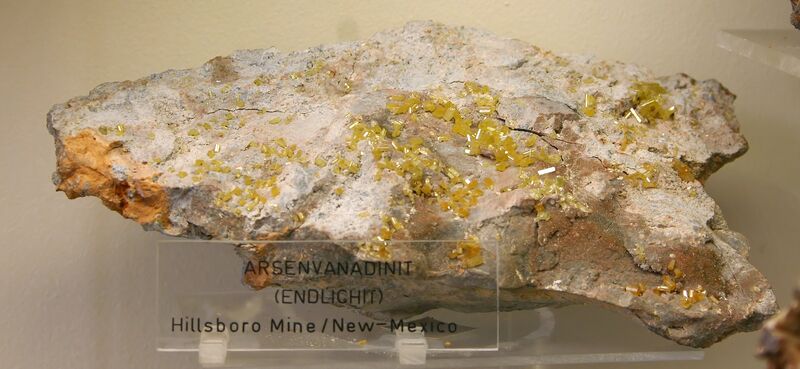
- Orange-red · red-brown · brown · bright red · yellow · whitish · pale straw-yellow · colourless or weakly tinted in transmitted light.
May exhibit zoned colouration due to varying composition.
- Streak
- White to pale yellow and light brownish yellow
- Tenacity
- brittle
- Cleavage
- None Observed
- Fracture
- Irregular/Uneven
- Density
- 6.88 g/cm³
Optical
- Optical type
- Uniaxial (-)
- Refractive index
- 2.35 – 2.416
- Surface relief
- Very high
- Principal indices
- nω 2.416 · nε 2.35
- Pleochroism
- Weak
Visible in tinted material in transmitted light.
Crystallography
- Space group
- #108
- Cell parameters
- a = 10.3174 Å · c = 7.3378 Å
- Z
- 2
- Morphology
Well developed hexagonal prisms [0001]; the prisms range from tabular to acanthine, and may be terminated by pinacoids or less commonly hexagonal bipyramids. Usually with smooth faces and sharp edges; sometimes cavernous, also acicular, hairlike, fibrous, rounded, globular, skeletalized. Crystals may exhibit concentric zones of varying composition.
Chemical composition
- Impurities
- P
- As
- Ca
Synonyms
- Chlorvanadinit
- Chromate de plomb brun
- Johnstonite (of Chapman)
- Lead vanadate
- Plomb brun
- Plomo pardo
- Vanadate of Lead
- Vanadin-spath
- Vanadinbleierz
- Vanadinbleispath
- Vanadinsaures Blei
In other languages
- French
- Chromate de plomb brun · Pb5(VO4)3Cl · Vanadinite
- German
- Vanadinit
- Spanish
- vanadinita
- Italian
- Vanadinite
- Portuguese
- vanadinita · Vanadinite
- Japanese
- 褐鉛鉱
- Chinese
- 钒铅矿
- Simplified Chinese
- 钒铅矿
- Traditional Chinese
- 釩鉛礦
- Russian
- ванадинит
- Arabic
- فانادينيت
Classification
8.BN.05
- 8Phosphates, Arsenates, VanadatesClass
- 8.BPhosphates, etc., with additional anions, without H2ODivision
- 8.BNWith only large cations, (OH, etc.):RO4 = 0.33:1Group
- 8.BN.05VanadiniteSpecies
41.08.04.03
- 41Anhydrous Phosphates, Etc.containing Hydroxyl or HalogenClass
- 41.08A5(XO4)3ZqType
- 41.08.04Pyromorphite GroupGroup
- 41.08.04.03VanadiniteSpecies
22.2.14
- 22Phosphates, Arsenates or Vanadates with other AnionsClass
- 22.2Phosphates, arsenates or vanadates with chlorideGroup
- 22.2.14VanadiniteSpecies
Group, growth & confusion
 AlforsiteBa5(PO4)3ClMineral—
 ChlorapatiteCa5(PO4)3ClMineral—
- FluoralforsiteBa5(PO4)3FMineral—
 FluorapatiteCa5(PO4)3FMineral—
- FluorpyromorphitePb5(PO4)3FMineral—
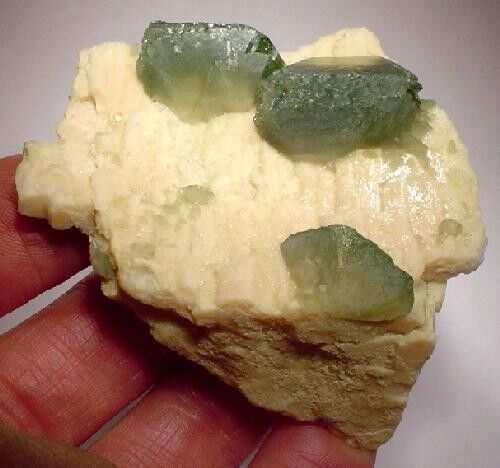 HydroxylapatiteCa5(PO4)3OHMineral—
- HydroxylpyromorphitePb5(PO4)3(OH)Mineral—
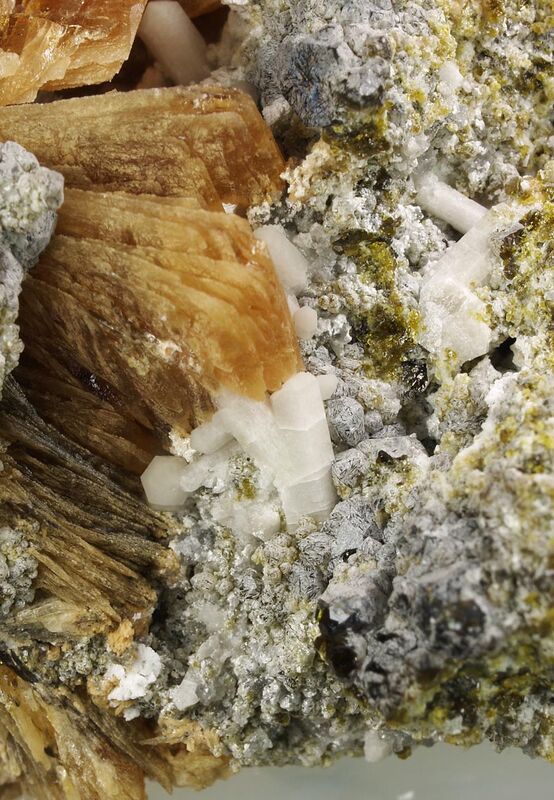 JohnbaumiteCa5(AsO4)3(OH)Mineral—
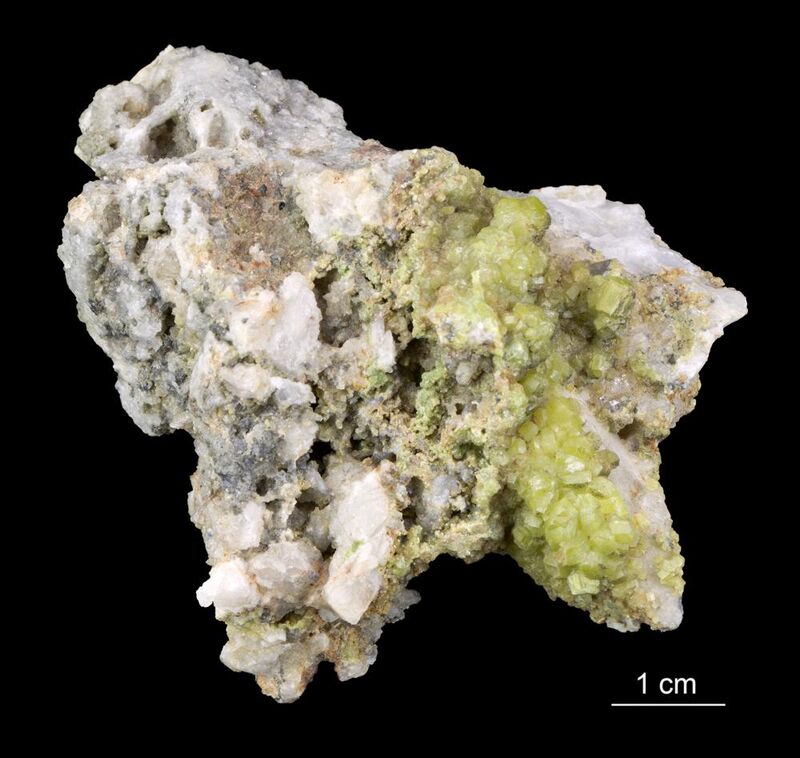 MimetitePb5(AsO4)3ClMineral—
- PieczkaiteMn5(PO4)3ClMineral—
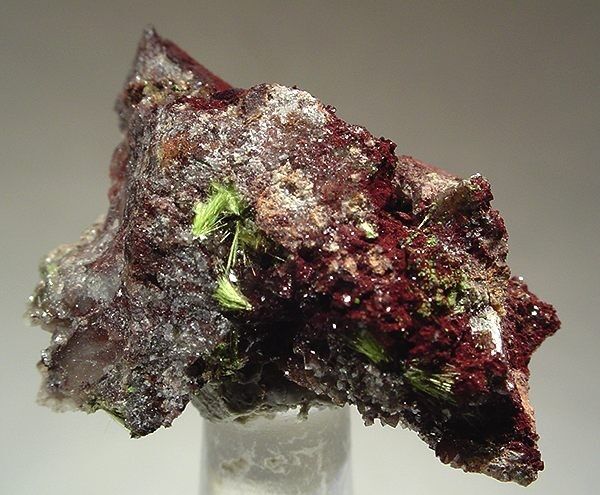 Agardite-(La)LaCu2+6(AsO4)3(OH)6 · 3H2OMineral—
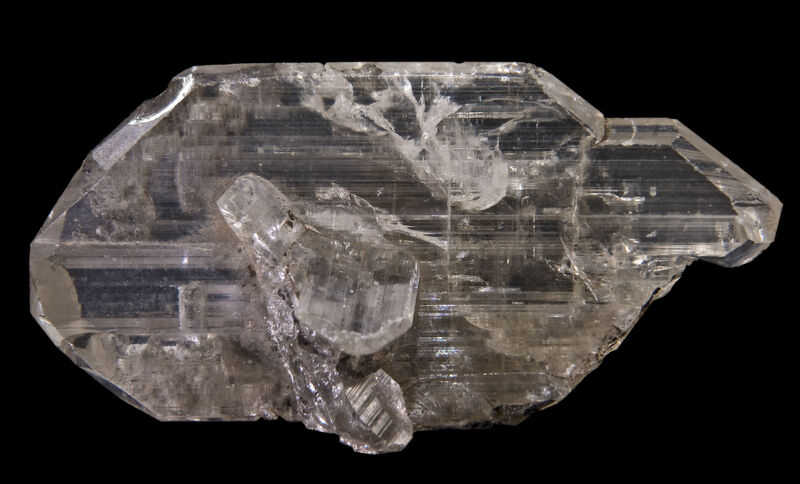 AnglesitePb(SO4)Mineral—
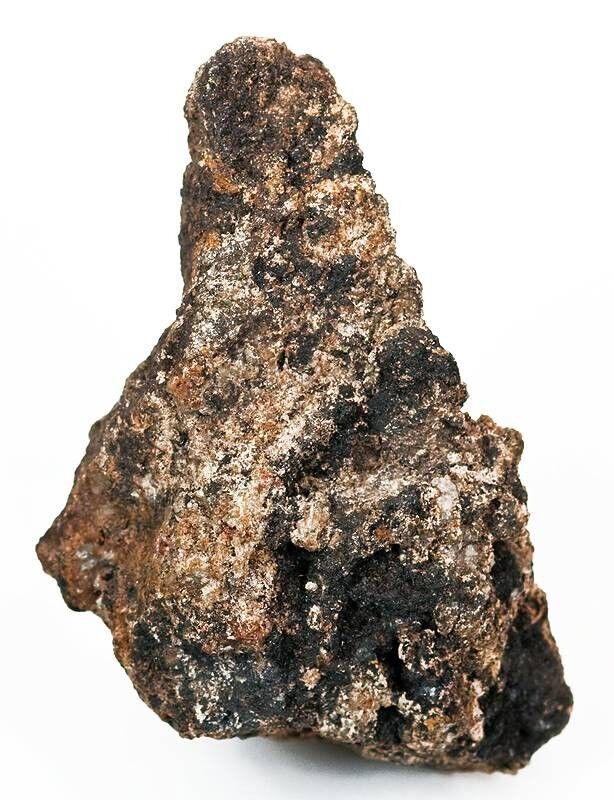 BrackebuschitePb2Mn3+(VO4)2(OH)Mineral—
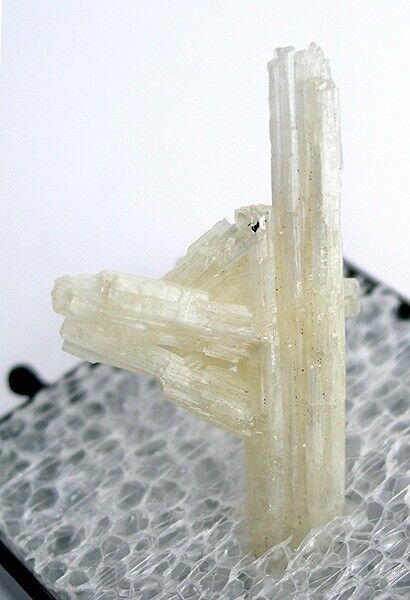 CerussitePb(CO3)Mineral—
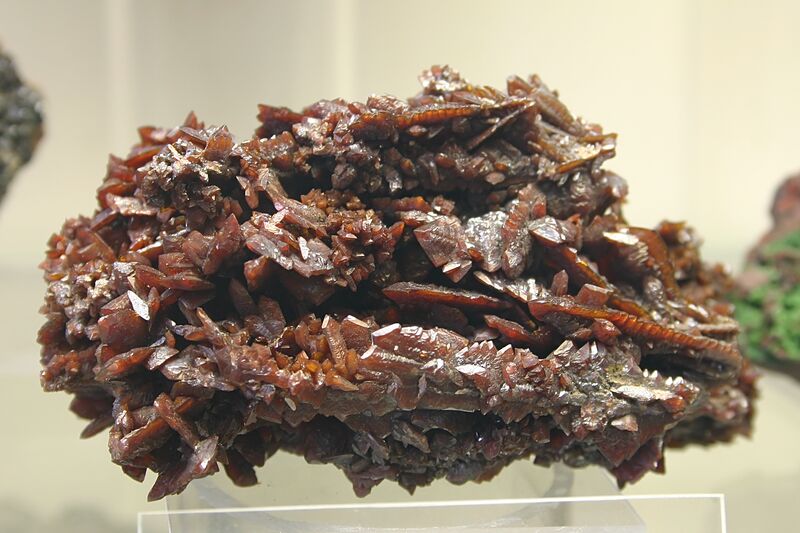 DescloizitePbZn(VO4)(OH)Mineral—
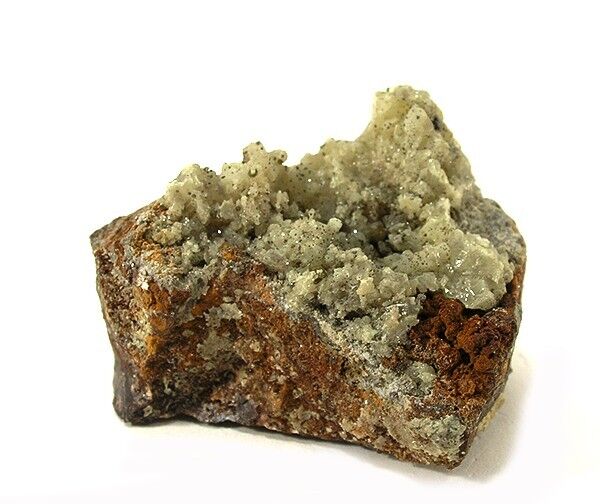 IodargyriteAgIMineral—
- MimetitePb5(AsO4)3ClMineral—
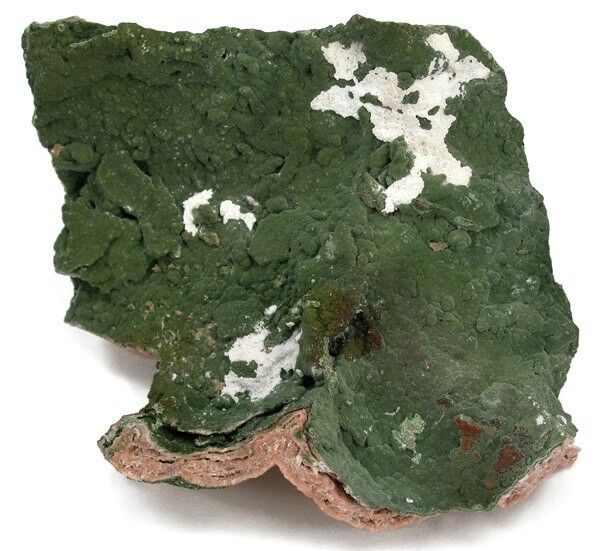 MottramitePbCu(VO4)(OH)Mineral—
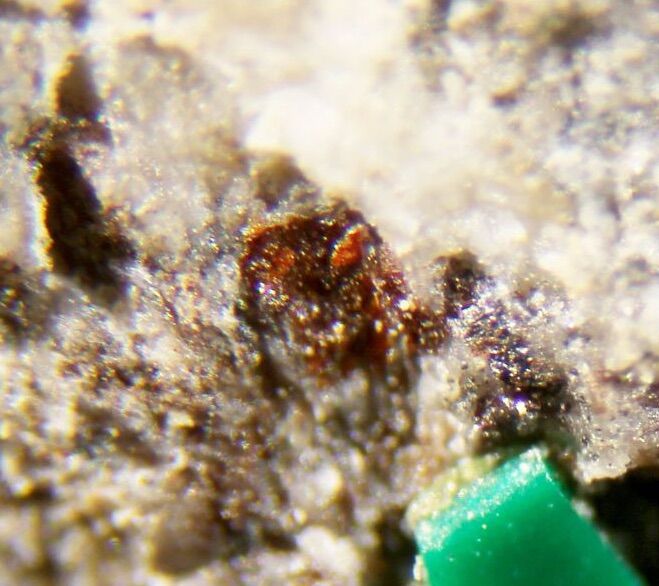 PyrobelonitePbMn2+VO4(OH)Mineral—
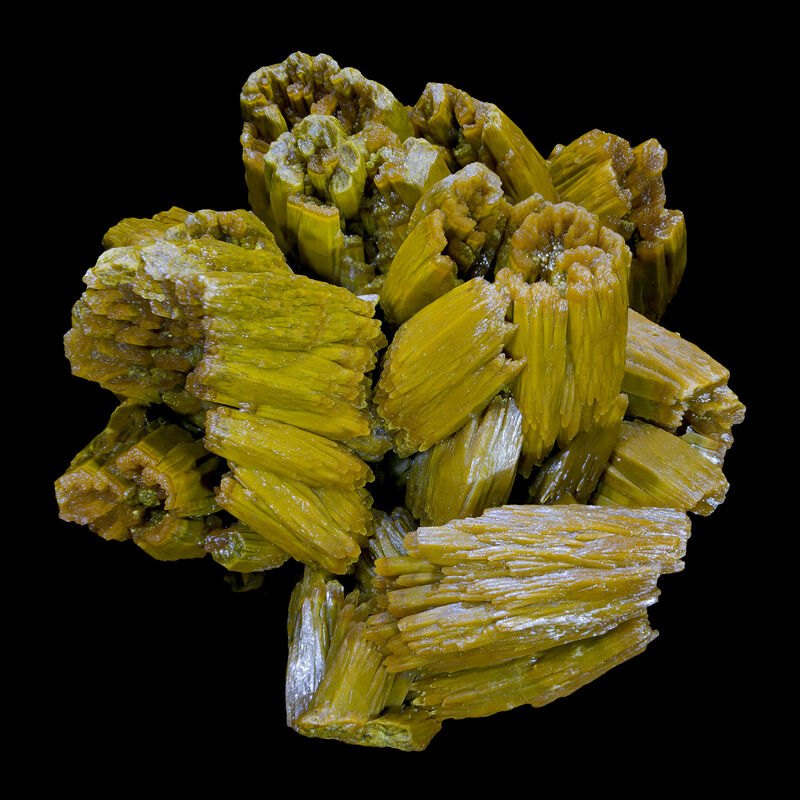 PyromorphitePb5(PO4)3ClMineral—
Literature, links & citation
- 1807Brongniart, A. (1807) Traité élémentaire de minéralogie, 2 volumes, 8vo, Paris: 2: 204 (as Chromate de plomb brun).
- 1833Rose, G. (1833) Ueber das Vanadinbleierz von Beresow im Ural. Annalen der Physik, Halle, Leipzig: 29: 455-458 (as Vanadinbleierz).
- 1838von Kobell, Franz (1838) Grundzüge der Mineralogie: Grundzüge der Mineralogie: zum Gebrauche bey Vorlesungen, sowie zum Selbststudium Entworfen. Johann Leonard Schrag.
- 1856Kenngott, A. (1856) Bemerkungen über die Zusammensetzung des Vanadinit (Comments on the composition of vanadinite). Annalen der Physik: 175(9): 95-101.
- 1880Rammelsberg, C. (1880) Ueber die vanadinerze aus dem Staat Córdoba in Argentinien. Zeitschrift der Deutschen Geologischen Gesellschaft: 32: 708-713.
Entry last updated
@misc{mineral2026,
  author    = {Mineral Index editorial board},
  title     = {Vanadinite — Mineral Index},
  year      = {2026},
  url       = {https://mineralindex.org/minerals/vanadinite-4139}
}